

My rule is that you get to write one book on higher education and if nothing changes, or things get worse, you had your chance. To write two books on higher ed is to admit your first book didn’t improve things. My rule assumes that the point of writing about higher ed is to change it, which means the book has to want to change things. Complaint (or lament, outrage, grievance, or protest) is central to the genre.
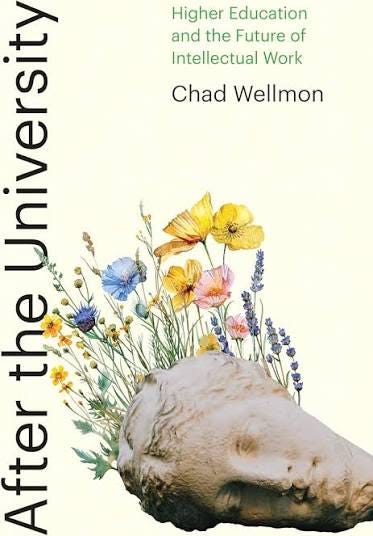
I knew of Chad Wellmon’s first book, Permanent Crisis: The Humanities in a Disenchanted Age (Chicago, 2021), written with Paul Reitter, which argued that the crisis of the humanities is as old as the humanities, that nineteenth-century German philologists invented the lament along with the discipline, and that crisis talk is the field’s founding genre rather than a report on conditions. The book, whose cover featured the statue of a naked torso with a missing head, asked the humanities to stop lamenting and think. I decided to read his new one, After the University: Higher Education and the Future of Intellectual Work (Johns Hopkins University Press), whose cover features a head with no torso, for three reasons. First, to see if Wellmon would explain why his first book did not effect the change he wanted; second, to see how he would treat AI; and third because I am writing my own book on higher ed, which I expect to be the only book I write on higher ed and which I trust will change things. I wanted to see if Wellmon and I were treading the same ground.
Does Wellmon say whether his first book changed anything? No. Curiously or honorably, in this era of self-citation, Permanent Crisis isn’t mentioned at all, though the phrase appears in lowercase on page 87, as a description of the German university around 1900. Things have certainly gotten worse since it appeared. Pick your metric; things have gotten worse.
Does Wellmon talk about AI? Barely. ChatGPT is a specter in the introduction and an anecdote in Interlude I: a course he taught on whether using it is cheating, and a dinner at which he and the provost imagined a degree without grades (122–123). You could argue it was early days when he was writing, given the long timeline between delivering a manuscript and a book appearing. Does Wellmon say what this book is for? He says two things, hedging on one. He promises, in the introduction, “an alternative idiom for thinking about higher learning” (13). But he confesses, in the conclusion, “At times, I thought that a new institution would emerge from the old one, one for which I could sketch a blueprint in this book. But I understand After the University differently now. It does not announce the collapse of an institution or herald its successor. It names a social situation” (363).
It’s a sad book, which you can judge by the cover. I suppose I share a certain sadness about the current situation, but I’m not a mourner. I want to change things.
Wellmon spends much of the book on university history, which is fine though it is well-trodden ground. Emily Levine’s Allies and Rivals: German-American Exchange and the Rise of the Modern Research University (Chicago, 2021) is as far as I’m concerned the best standard history. Levine’s focus is on the academic social contract, how universities made the bargain that gave them autonomy and money in exchange for productive service to the state. Allies and Rivals is not cited here either. Levine is continuing that work at Stanford with Mitchell Stevens: the November 2024 white paper Private Universities in the Public Interest, and a January 2026 Council of Independent Colleges keynote on “The Academic Social Contract.” I was part of the September 2024 “Private Universities in the Public Interest” gathering at Stanford, which strengthened my commitment to halting the slide to mediocrity and irrelevance I see across the higher ed sector.
Wellmon marches through the origin story to the Clark Kerr story and the late 1950s, when, as Kerr recalled, economists came to regard human capital as “more important than physical capital itself” (227) — Gary Becker, Milton Friedman, and the 1960 California Master Plan. Wellmon writes that human capital theory “did not turn American universities into a system of acquisitive institutions”; it “clarified in simple and easily communicable terms what the value of higher education had already become” (228). Most people, like Wellmon, focus on the UC system.
I know this story well from my years as dean of arts and humanities at Sonoma State University, in the CSU system. I saw firsthand the widening gap between quality public higher education and what is happening at struggling places that will do almost anything to keep students enrolled and keep tuition dollars flowing. The deeply troubled CSU system is still the largest four-year public university system in the country and is far more representative of the dismal state of higher education today than Harvard or Columbia or Vanderbilt or UT Austin or any of the schools that dominate the discourse.
Wellmon is a professor at the University of Virginia, one of the most elite public universities; he’s taught German there since 2007. He has been at least waist-deep in the bureaucracy, leading a faculty effort to reform the undergraduate curriculum from 2014 to 2021. He served as the principal of Brown College, one of UVA’s three residential colleges, overseeing 300 students. “In all my time as Brown principal,” he writes, “I met just one undergraduate who had actively decided to go to college” (351). UVA students travel an expected path that will ensure their continued class status.
Wellmon focuses almost entirely on the top tier of institutions, where a scholar can afford to distinguish the open pursuit of disciplined study from the container called “the university,” which Wellmon sees as broken. His Chapter 7 follows W. E. B. Du Bois out of the research university into the Black colleges, where in 1933 Du Bois told a Fisk audience they had given themselves to “semi-professional athletics and Greek Letter societies” and an “overwhelming appetite for wealth” and had “abandoned real education.” (Atlanta’s trustees forced him out in 1944.) And Chapter 13 follows the postwar African university to its decline. “The African struggle for an African university had failed” (334). But nowhere in the book is any American institution outside the top tier.
Wellmon’s central complaint is that an institution that claims to be about knowledge actually functions as a system that sorts, credentials, and distributes the external goods of money, status, and work. I truly did almost sigh.
And then, almost as an aside, Wellmon writes that in 2017 he “encountered a parallel institution” he was unprepared for (205), by which he means the entire apparatus of the Office of Residential and Student Life, Financial Aid, Student Health Services, Dining Services, the campus police, parent groups. Indeed you don’t really see this whole other bureaucracy as faculty. I didn’t encounter it until I was a dean. Yes, there is an entire bureaucracy dedicated to managing students’ lives outside the classroom, keeping them on a conveyor belt that tracks their outcomes and guiding them to graduation as smoothly and effortlessly as possible with modern technology. Wellmon calls it the Other University. It governs more of the students’ college experience than the classroom does. And at the time of his writing, UVA did not seem to have embraced predictive analytics, new technologies that allow students to “navigate” their “learning journey” so efficiently that the moment they declare their major, their map to the finish line is laid out for them, the right classes in the right order, faculty standing ready to “deliver instruction” when it comes their turn.
It’s hard to be angry at Wellmon’s surprise. The growing student-success infrastructure is causing the end of the university he loves. “I had embraced my own fantasy: the academy as the real core of the university” (205). Wellmon, like most faculty, had previously seen student affairs as necessary extracurricular bureaucracy. He at least acknowledged his disenchantment. The two reviews of his book I’ve seen so far, Nils Gilman’s and Steven Mintz’s, do not mention the Other University at all. It is as if they don’t want to see why the enterprise is failing. They prefer to see the curriculum at the center and faculty as the keepers of disciplined study, with student success as a kind of parasite. But universities are no longer curriculum-centered. They are student-centered.
But I’m glad Wellmon recognizes the problem, even if he turned away, to mourn. My readers here know my focus on bureaucratic kludge. None of the bureaucracies I write about appears in his book. “Learning outcomes” does not appear at all (though he focuses a bit on “outcomes” generally). “Transfer” isn’t discussed, even though, in 2018, the Virginia General Assembly passed HB 919, and in July 2019 the State Council of Higher Education adopted rules under which 16 or 30 to 32 credits of general education taught at any Virginia community college satisfy the lower-division requirements of every public four-year institution (except VMI), whether or not the receiving institution offers an equivalent course. Wellmon does not seem to recognize that he spent seven years reforming lower-division requirements at UVA that the state then declared satisfied by coursework at any Virginia community college.
It took me nearly seven years as a dean at two universities to see the whole of what is causing the current crisis in higher education, which I most recently wrote about here. Wellmon’s After the University offers a lament for a lost fantasy (a term he returns to again and again): “a desire for intellectual community, excellence in thinking, and the intrinsic goods of learning, knowing, and thinking” (351). I am by this time too jaded by what I’ve seen to even think about using that word myself, but I am glad that Wellmon has it and that people still see the university as someday returning to something better than the wreck it is now.
I’ll be taking my one shot next year.
Hollis, Gotta respect your focus. I do. The fact that it took me so long to grasp the import of the Other University (and that i could name it as such) probably does say as much about my own blinkered life as much as anything else. I’ll add just two things. 1) It’s true this book ended up not being the roadmap or blueprint I had hoped it’d be when I first started writing it. I thought the conclusion would sketch some future university. But the writing and thinking of it changed me and the world changed as I did. In the end, I came to think that the university wasn’t enough. (Funny enough, part of that was trying to work with CCs here in VA, funny in that ironic sense related to all the reasons you’ve written about regarding GE) 2) That conclusion was, for me at least, kinda liberating. And yet, it certainly left me still trying to figure out where we are and what we want. Thanks for this, Chad
"I am writing my own book on higher ed, which I expect to be the only book I write on higher ed and which I trust will change things."
Speaking from experience, this is a necessary belief while writing a book, but an unreasonable goal to hold oneself to longterm.