

One of the biggest myths in higher education, I tell parents, is that accreditation has anything to do with the quality of a college or university. It doesn’t, by law. Since the 2008 Higher Education Opportunity Act, all an accreditor can do is rate student achievement by the standard each institution sets for itself. That means no accreditor looks at the quality of any of the ingredients that go into any college course or degree: not the professor, not the reading list, not the time spent mentoring or writing letters of recommendation. Nothing about what makes a college “good.”
“No accrediting agency or association may be determined by the Secretary to be a reliable authority as to the quality of education or training offered for the purposes of this chapter or for other Federal purposes” (20 U.S.C. §1099b(a))
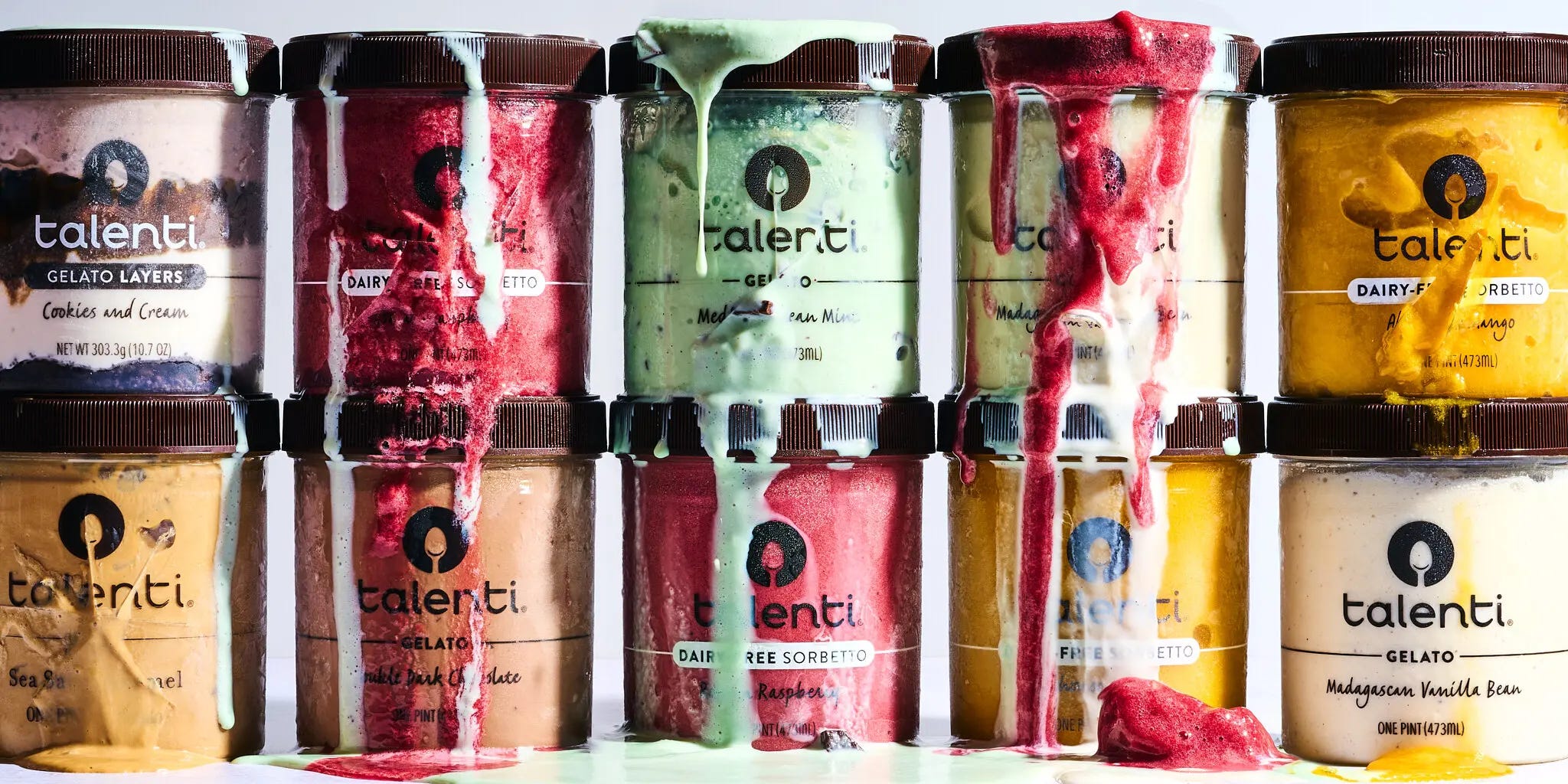
What parents can’t get their heads around is how a college can be fully accredited, can cost more every year, and yet still be worse than it was when they went. I’ve watched this decline for twenty years and I’ve never been able to explain it in a way that sticks. Then I read last week’s viral New York Times Wirecutter story about Talenti gelato.
Times writer Annemarie Conte explained that she had been a Talenti loyalist since 2012. Like millions of consumers, she loved the fancy flavors that came in a distinctive, reusable see-through plastic container with the screw-top lid. So when the Wirecutter team blind-tasted the vanilla and ranked it subpar, “thin, gray, foamy,” Conte didn’t believe them. How could a quality product go downhill so fast? She interviewed the founder and a food scientist and tracked down old labels from friends who had kept old Talenti jars. She compared the listed ingredients over the past ten years. Many had changed, and not in a good way.
I want to make two comparisons here. First, no higher ed accreditors do anywhere near the kind of work Conte does. I’ve been involved in accreditation reviews at four universities over the past twenty years. Regarding academics, at least, it’s pretty much all paperwork. Here are pieces of paper with numbers of courses, learning outcomes, names of professors with degrees after their names. There’s no equivalent of a taste test. There’s no concern with quality, by law. So there’s no attention to whether things have gotten better or worse over time.
Second, let’s pretend a container of gelato is a college course and a shelf of multiple flavors is a department or school. No, this isn’t exact. A single worker is not responsible for a particular jar of ice cream. But Conte’s article offers a helpful way to explain how two nearly identical containers could hold contents with very different quality.
Consider the term “course shell,” which became common with the first learning-management systems (LMS), WebCT and Blackboard, in the late 1990s. Canvas arrived in 2011. A shell is an empty online classroom waiting to be filled: a place for the syllabus, readings, assignments, discussion boards, and grades. Faculty embraced the practical side of it. No more student excuses about printers running out of ink, no more waiting after office hours for a paper to be dropped off.
Like a gelato jar, the LMS shell is created before the product, a concept with a course number and title. Curriculum committees approve credit hours, catalog descriptions, prerequisites, and learning outcomes beforehand. By the first day of class, the jar and label are already there.
You probably expect that I’ll make the analogy that learning outcomes are like a standard nutrition label, that an accreditor scans them closely the way a shopper scans for sodium, iron, or calories. But no, learning outcomes are not about nutrition. Learning outcomes are worded to match other institutions’ learning outcomes on their course shells. In Colorado, for example, the learning outcome sentences must be pasted into each instructor’s syllabus before the course begins. All they’ll tell you is what someone somewhere thought you might get out of the course should you open the screw-top lid and taste it.
Here’s a typical “learning outcome” for a biology course shell: “students will accurately understand and describe the scope of scientific study and core theories and practices, in either or both the physical and biological sciences, using appropriate discipline-related terminology.” This could mean pretty much anything you find on the internet when you search “biology.” Here’s a typical Humanities one: “analyze, interpret, and/or evaluate primary works that are products of human imagination and critical thought,” which would apply to a course on Shakespeare, film, or comic books.
State learning outcomes requirements have the same vibe as food packaging bureaucracy. Federal regulation 21 CFR 101.4 requires every ingredient in a gelato pint to be listed on the package by weight. Since the FDA has no definition of the word “gelato,” if it is less than ten percent milkfat (above which it would be ice cream), the legal designation is “frozen dairy dessert.” As the pastry chef and author Dana Cree told Conte, you can write gelato on a container and put whatever formula you want inside.
According to Talenti’s founder (who sold the company to Unilever in December 2014), in the absence of an advertising budget, the see-through jar would do double duty as container and signal of luxury. The jar is so distinctive, recognizable, and consistent—same shape, same lid, same shelf presence—that nobody really noticed when contents began to decline.
You see the parallel with higher education. States and accreditation agencies look at the jar and the lid and nothing else. Florida Statute 1004.085, for example, simply requires learning outcomes for every class. The U.S. Department of Education in 2011 decided to define ‘credit hour’ as “amount of work represented in intended learning outcomes and verified by evidence of student achievement.” No state requires anything like an actual ingredients list. Just a jar labeled gelato and a lid.
Higher education journalists are encouraged by well-funded foundations dedicated to transferability to laud this mass production of course shells and learning outcomes because everyone should be able to have gelato, not just the rich.
Annemarie Conte’s piece went viral because she went back, found old ingredients lists, and showed how the recipe had gone from yum to yuck: fresh mint became mint “extractives;” rare Tahitian vanilla became common Madagascan beans and then “specks” (ground husks); carob gum picked up tara gum and guar gum.
Gums are stabilizers, Conte explains, added so the gelato survives mass shipping. In a gelato shop, the gelato is made and eaten in the same shop, within days. You can’t scale up to deliver globally without losing something. When you have to pack your gelato and blast-freeze it to get to grocery stores around the country you’ve got to optimize for more than taste. Bulk and stability are the goals.
Again, you see the comparison. Courses optimized to travel to every other university in the state or country taste worse. Think about recorded lectures, machine-graded quizzes, matching learning outcomes as stabilizers, like gums. Blech.
The problem is that there are no Annemarie Contes, there’s no Wirecutter generally for higher ed. And it’s worse. With frozen dairy desserts, you could just decide you don’t want to eat a particular brand. But you can’t really choose a college this way because at the level of lower-division classes, at least, brand does not signify quality (or even declining quality) and the containers are interchangeable by design.
Let’s say you want a quality college degree just like you want a quality frozen dairy dessert and you decide to go to Häagen-Dazs or Van Leeuwen College, which Wirecutter rates as the best vanilla ice cream. I’ll choose Van Leeuwen, deemed “rich, custardy, and grown-up.”
Even if you go to Van Leeuwen College, it may be that a good part of your graduating class took their classes from Talenti College—not back in 2015, when it was good, but last year. If these colleges were in Florida, Van Leeuwen College would be required to say that there is no difference between the containers. According to Florida’s §1007.24(7), a transfer student “shall be awarded credit” for courses faculty committees have judged “academically equivalent to courses offered at the receiving institution,” which means as long as it’s in the same container with the same lid, labeled with the same course number and learning outcomes. California does this too, with CalGETC. All frozen dairy desserts are the same to most states right now, whether they taste good or not.
This declining quality problem was a problem before AI, before it was the case that half of your classmates were using AI agents to do the work. AI agents do not care about the taste or quality of frozen dairy desserts.
If I were president of a small liberal arts college with a decent reputation right now, I would do what St. John’s College does and simply refuse the container system and get out of the shell game. (I fear this would be impossible at a big state school.) St. John’s accepts no transfer credit from anyone: no AP, no IB, no CLEP, no courses from another college. Every undergraduate starts the four-year program from the beginning. There are famously no majors, no departments, no catalog of interchangeable three-credit units. Students do not go there expecting to transfer. They go there because it is different and the recipe has barely changed since 1937.
Not every college has to be St. John’s, but every college has to care about the quality of its own brand. Parents and students too have to stop hedging their bets and saying, “if I don’t like it, I can transfer and my courses will count.” If you design your school to serve every student in the same standardized way, via course shells and learning outcomes, you will disappoint the individuals who used to see what you offered as distinctive and excellent.
There’s so much I could say about this story. As someone who’s taught at a university for about 12 years now, it’s strange to see something I’d taken as normal described this way. But it maps onto something I’d felt and hadn’t been able to articulate.
I’ve always been lucky to teach electives and upper-level courses. But it was always told me that the outcomes belong in the syllabus. As you’ve suggested here, they’re so broad (and I’m also so meticulous about what I teach) that it’s easy for me to show how what I’m doing meets those standards.
That being said, I think what St. John’s does is interesting. I’ve always looked up to them, and my dad tried to get me to go to a school like that, but I was too interested in going to a big state school where I could party anonymously after 13 years of prep schools. I think the issue is that they've opted out so hard, they produce a very specific type of independent thinker who doesn't always map onto what most people think is prestigious.
The first institution that finds a way to opt out the way St. John’s has, but in a manner that maps to striver sensibilities and attracts the kind of people who currently aim for the Ivy League (and Y Combinator and their equivalents) will take off into the stratosphere.
I couldn't not reply to this.
My dad, Tom Cannon, died earlier this year. He created the first Times Good University Guide and UK university league table. That was back in 1992.
Back then, it was controversial even to try and answer the question. Reputation was self-validating. Oxford was Oxford. Cambridge was Cambridge. A new university was a new university. Everyone knew that.
Dad included graduate employment prospects. Always a champion of students, he believed you should look at what a university did for them. That was more important than reproducing an existing hierarchy of prestige.
Of course, once you turn things into a league table, you have to measure things consistently. Many important parts of education are the things that resist that measurement.
So that Wirecutter analogy hits home.
Dad would have been sympathetic to the idea of a Wirecutter for universities. Not another universal ranking. Something observational. Sit in the classroom, talk to the students, look at what's taught. Is the thing sold under the name the same as what people think they're buying?
Transparency helps a lot. But you're right to challenge us to get better at tasting the gelato.